MEKSMART
GENERAL NEWS

Author: Meksmart .
Update: 23/12/2025
MEKSMART | SUPPORTS HOUSEHOLD BUSINESSES IN TAX TRANSFORMATION
Starting in 2026, households and individual businesses will have to switch from paying fixed taxes to tax declaration, meaning all revenue and expenses must have legal invoices and documents. This regulation leaves many household businesses confused as they need to change habits, adopt technology, and manage invoices and documents according to new standards.
So, what should household businesses and taxpayers prepare to ensure the declaration process is quick and smooth? Let’s explore with Meksmart in this article!
1. Transitioning to Tax Declaration: What Challenges Do Household Businesses Face?
Switching to tax declaration certainly comes with many challenges. The biggest difficulty is changing traditional work habits. Many household businesses still record transactions informally, without clear tracking of revenue and expenses. When moving to declaration, they must get used to daily record-keeping, storing invoices, tracking eligible expenses, and issuing electronic invoices for each transaction.
Technology barriers remain a major obstacle for many household businesses. Tasks such as preparing tax returns, using digital signatures, or troubleshooting system errors often cause confusion, especially for those unfamiliar with software. Additionally, fear of mistakes and penalties for late or incorrect declarations makes them hesitant to fulfill tax obligations.
Another common issue is the lack of valid invoices and documents. Many customers are used to buying without requesting invoices or receiving improperly formatted invoices, making it difficult for businesses to justify expenses. Without sufficient documentation, those expenses are not recognized, resulting in higher tax liabilities than expected.
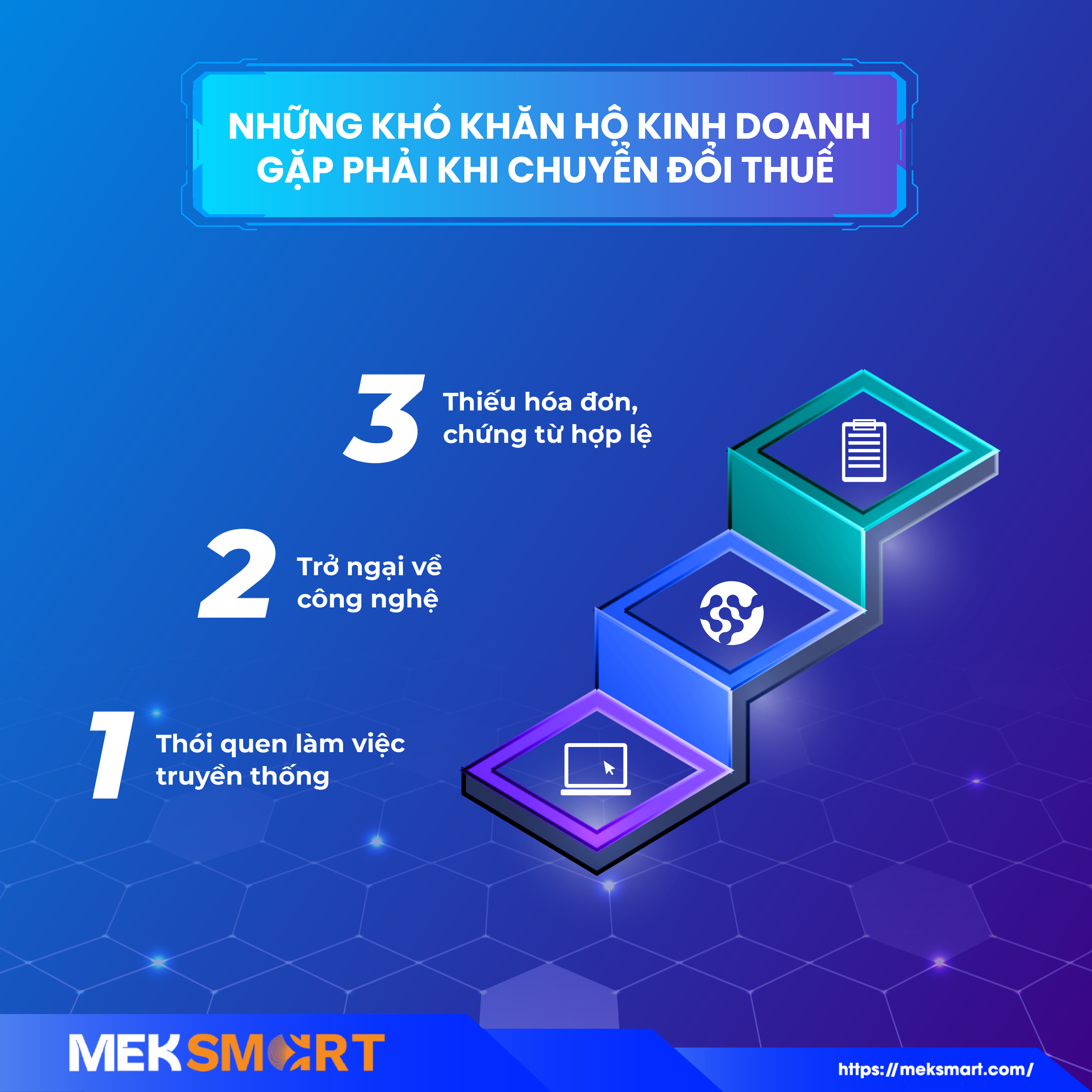
Challenges Household Businesses Face During Tax Transformation
2. Steps to Help Household Businesses Declare Taxes Quickly, Accurately, and Completely
To adapt to the new regulations, household businesses need to understand the laws and prepare thoroughly. The transition is not too difficult, but it requires a proper, complete, and controlled process.
Businesses must re-register their tax payment method, switching from fixed tax to declaration based on actual revenue. This is the first and most important step for the Tax Authority to update information and guide taxpayers through the new process.
In addition, revenue and expense tracking must be continuous and systematic. This can be done using notebooks, Excel, or, most conveniently, sales management software, which allows real-time revenue monitoring and complete data storage for tax declaration.
Finally, to minimize errors, taxpayers should use tax declaration support software. These tools automate most tasks, consolidate revenue and expenses, reconcile data, and generate reports with just a few simple steps. Not only do they reduce mistakes, but they also significantly shorten declaration time—especially useful for those unfamiliar with technology.
Essential Preparations for Household Businesses
3. Meksmart – Supporting Household Businesses in Transitioning from Fixed Tax to Declaration
To meet the demands of the new era, Meksmart continuously updates modern technologies in line with global trends, supporting household businesses in effective digital transformation.
Through strategic cooperation with MISA, Meksmart has introduced the MISA HKD application - a sales management software integrated with electronic invoicing, tax declaration, and accounting. MISA HKD complies with Decree 70/2025/NĐ-CP, Circular 88/2021/TT-BTC, and Circular 40/2021/TT-BTC.
To date, Meksmart has been “empowering” thousands of household businesses during this transition, delivering positive results: data is continuously synchronized, tax declarations are more accurate, and tax authorities can provide better support to small traders. When invoices, revenue, and reports are tightly connected, tax authorities can even handle part of the technical work, reducing administrative pressure on businesses.
Meksmart Supports Household Businesses in Tax Transformation
Not stopping at the “60-Day Campaign to Support Household Businesses Transition from Fixed Tax to Declaration,” Meksmart will continue to innovate to help businesses confidently adapt to tax changes. Contact us now for timely consultation and support!
Feature News

MEKSMART TECHNOLOGY SOLUTION CO., LTD
Email : info@meksmart.com
Hotline : (+84)822923650
Offiice : SBI Building, Lot 6B, Street 3, Quang Trung Software Park, Trung My Tay Ward, Ho Chi Minh City, Vietnam
Industries